A rolled ankle on the court in Hastings. A shoulder that catches every time you throw. A low back that tightens up after a Saturday of yard work and a Sunday morning run. Sports injuries rarely announce themselves with drama. Most of them build quietly until the movement you love stops feeling natural.
Murray Natural Integrated Health works with high school athletes, weekend warriors, runners, lifters, and working adults across Hastings and the Tri-City area. Care here is drug-free and root-cause focused, combining chiropractic adjustments with shockwave therapy, PEMF, physical therapy modalities, and functional medicine support. The goal is not to mask a symptom long enough to finish a season. It is to find out why the tissue broke down and give your body what it needs to heal and stay strong.
Pain is information, not the problem itself. A sore knee after a long run may start in the hip that will not rotate. A shoulder that aches during overhead lifts may trace back to a stiff mid-back. When one joint stops moving well, the joints above and below compensate, and the tissue that ends up doing extra work is usually the tissue that gets injured.
Chiropractic care approaches the body as a whole, self-healing system. Your brain and spinal cord control how every muscle fires and every joint tracks, and when that communication is compromised by restricted motion or misalignment, overall performance suffers. Rather than reaching for medication to quiet the signal, care at Murray Natural Integrated Health focuses on restoring normal motion, calming irritated tissue, and supporting the nutrition and lifestyle factors that let injuries actually repair.
Most of the athletes who walk through the door fall into a handful of patterns. Some are acute, from a single bad step or an awkward landing. Others are the slow burn of overuse that shows up weeks into a season.
Ligament sprains and muscle strains are the most common injuries in nearly every sport. Once the initial swelling settles, the joint often stays guarded and stiff. Chiropractic adjustments and soft tissue work help restore range of motion so you can rebuild strength in the right position instead of compensating around a joint that never fully recovered.
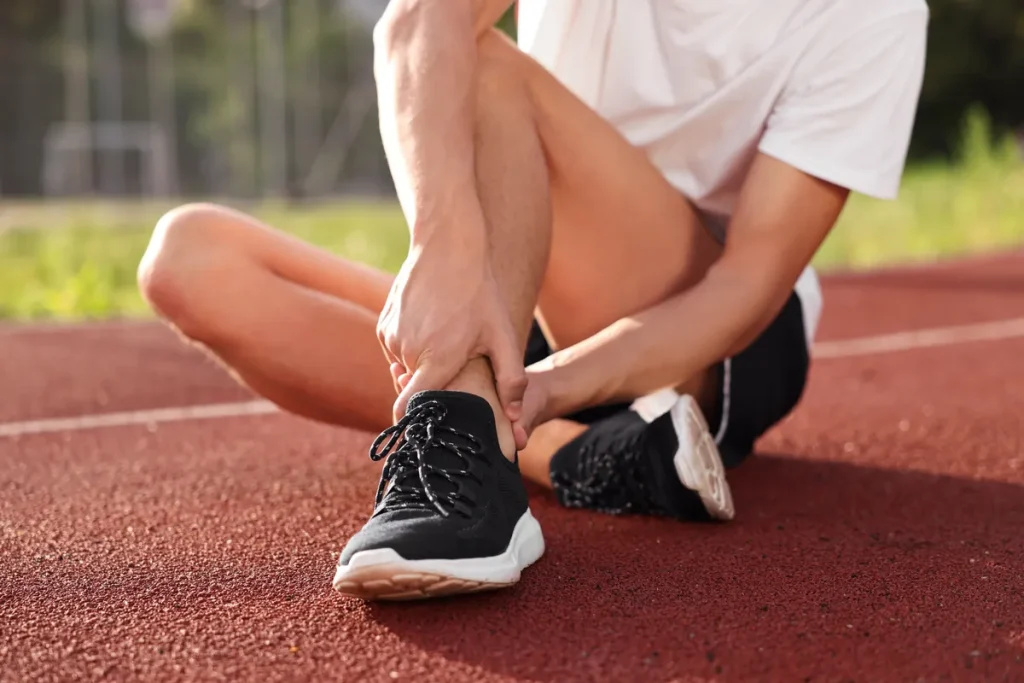
Tendons get irritated when load outpaces their capacity to adapt. That can happen from a sudden jump in training volume, poor mechanics, or simply years of the same motion. Shockwave therapy and progressive loading strategies are a strong pairing for these stubborn cases, especially when a tendon has been grumpy for months rather than days.
These three areas account for a large share of the athletes seen in Hastings. Knees complain when hips and ankles do not do their share. Shoulders complain when the mid-back is stiff. Backs complain when the core and glutes are not contributing. Treatment addresses the whole chain, not just the spot that hurts.

Adjustments restore motion in joints that have become restricted. For an athlete, that can mean a hip that finally rotates through a full stride, a mid-back that lets the shoulder reach overhead without pinching, or an ankle that bends well enough to absorb landing forces again. Better motion means better mechanics, and better mechanics mean less stress on the tissue that has been carrying the load.
Sessions are tailored to your sport and your stage of healing. An athlete two days out from an ankle sprain is treated differently than a runner six weeks into a stubborn Achilles issue. Adjustments are combined with soft tissue work and corrective exercise so the changes hold between visits.
Shockwave therapy delivers targeted acoustic energy into injured tissue. It is used for tendon and soft tissue complaints that have stalled, including chronic Achilles, patellar, and elbow issues, and it is a drug-free option for athletes who want to avoid injections or long stretches of rest. Sessions are typically brief, and many patients pair shockwave treatments with adjustments and rehab work for a more complete recovery plan. Your provider will explain what to expect for your specific injury.
PEMF, or pulsed electromagnetic field therapy, uses electromagnetic pulses to support the body's own recovery process. It is often used to help calm inflammation and support tissue healing alongside chiropractic care. Physical therapy modalities round out the plan with guided stretching, strengthening, and movement retraining so that gains made in the treatment room translate into performance on the field, the track, or the gym floor.
| Therapy | Best suited for | Role in recovery |
|---|---|---|
| Chiropractic adjustments | Restricted joints, compensation patterns, back and neck pain | Restore motion and alignment so muscles and joints work together |
| Shockwave therapy | Chronic tendon and soft tissue injuries | Stimulate healing in tissue that has stalled |
| PEMF | Inflammation and slow-healing tissue | Support the body's natural repair processes |
| Physical therapy modalities | Weakness, poor mechanics, return to sport | Rebuild strength, mobility, and control |
| Functional medicine | Slow recovery, recurring injuries, low energy | Address nutrition, inflammation, and whole-body factors |
Tissue heals with raw materials. If you are low on key nutrients, chronically inflamed, or running on poor sleep and high stress, recovery slows down no matter how many adjustments you receive. Functional medicine evaluations, including blood-based nutrition reports, help identify what may be holding your recovery back.
For athletes, that information can be practical. It may shape a conversation about protein intake, hydration, micronutrients involved in tissue repair, or lifestyle habits that affect inflammation. The aim is to support the body's own healing capacity so injuries resolve faster and the next one is less likely to happen.
Prevention is where athletes get the most long-term value from care. A few consistent habits go a long way, whether you are a high school competitor, a rec league regular, or someone who stays active through work and weekend projects.
Hastings is a community where people stay active. There are teams to play on, trails and roads to run, weight rooms to work in, and long days of physical labor that ask a lot of backs, knees, and shoulders. Murray Natural Integrated Health is built for that reality, offering drug-free, natural care under one roof so athletes do not have to coordinate care across multiple offices.
Care is designed to fit around a season, a work schedule, and a training plan. If you are unsure whether your injury is a good fit for chiropractic and integrative care, the first step is a conversation and an exam. Confirm current scheduling details, availability, and any insurance or payment questions directly with the clinic before your visit.
If a nagging injury is keeping you off the field, out of the gym, or away from the activities you enjoy, do not wait for it to resolve on its own. Contact Murray Natural Integrated Health in Hastings to schedule an evaluation and talk through a drug-free, root-cause plan built around your sport and your goals. Visit murraynaturalhealth.com or call the clinic to book your first appointment.
In most cases, no referral is required to schedule a chiropractic evaluation. If your injury happened at work or during a school sport, check whether any specific paperwork or clearance is needed. Calling the clinic before your visit is the simplest way to confirm what to bring and how scheduling works.
Earlier is generally better for guidance on what to do and what to avoid. Some injuries need a short period of protection before hands-on care, while others benefit from care quickly. A provider can assess your situation and recommend timing, so call and describe what happened rather than guessing.
Chronic tendon problems often need a combination of approaches rather than a single treatment. Shockwave therapy, adjustments to address mechanical contributors, and progressive loading exercises are commonly used together for these cases. Your provider can evaluate whether this combination fits your injury and explain what a realistic timeline looks like.
Young athletes are commonly seen for sports injuries, and care is adapted to their stage of development and training load. A thorough history and exam guide what is appropriate. Parents are encouraged to ask questions during the visit and to share any relevant medical history, imaging, or guidance from other providers.
The first visit typically includes a health history, a discussion of your injury and training, and a physical exam to identify what is driving the problem. Your provider will explain findings and outline a care plan. Bring a list of medications and any relevant imaging or reports to make the visit as useful as possible.
Bring in your blood test results for a wellness evaluation and 2nd opinion! Get to the causes of your conditions.
Call 402-463-4257 or send us a message and we will get you scheduled.
1934 West 2nd Street, Hastings, NE 68901