
Leg pain that starts in the low back and travels down through the buttock can make everything harder. Sitting, standing up from a chair, driving to work, even sleeping becomes a negotiation with your own body. For people in Hastings and the surrounding Central Nebraska communities, sciatica pain relief often starts with understanding what is actually irritating the nerve, then working on that cause instead of only muffling the symptom.
At Murray Natural Integrated Health, we treat sciatica as a mechanical and inflammatory problem with a source. That source might be in the spine, in the soft tissue around the nerve, in the way you move, or in the chemical environment your body is running on. Finding it changes the plan.
Sciatica is not a diagnosis in the way a broken bone is. It is a description of symptoms that follow the path of the sciatic nerve, which is the longest nerve in the human body. That nerve stretches from the spinal cord all the way to the end of each leg. When it becomes inflamed, the pain can land in the lower back, the buttock, or anywhere down the leg, and it frequently brings numbness, tingling, and muscle weakness along with it.
Because the nerve is so long, the location of your symptoms matters. Pain that stops at the hip describes a different situation than pain that shoots to the calf or the foot. A practitioner who only asks "where does it hurt" is missing half the picture. The better question is where the nerve is being compressed or irritated along its route.
According to standard chiropractic patient education, the sciatic nerve may become inflamed for a number of reasons, including age-related changes in the spine, obesity, and a sedentary lifestyle. In most cases, sciatica develops gradually as the nerve is compressed over time rather than appearing out of nowhere overnight.
That gradual buildup is useful information. It means there is usually a history to trace:
Several of those factors can be present at once. A patient who sits most of the day, carries extra weight, and has age-related spinal changes is dealing with three contributors, not one. Treating only the spine and ignoring the rest tends to produce relief that fades.
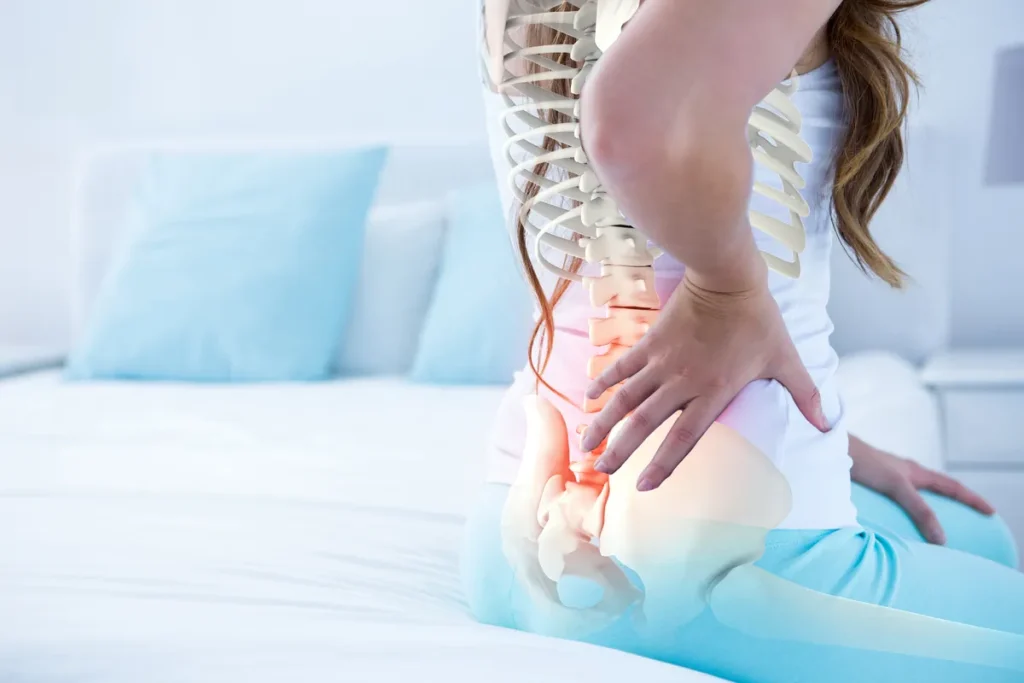
Over-the-counter pain medication is commonly listed as part of routine sciatica care, alongside rest, ice packs, and physical therapy. It has a place, particularly in the early, sharp phase when you need to function. The limitation is that pain medication interrupts the sensation of pain without changing the pressure on the nerve or the inflammation around it.
Think of it as turning down a smoke alarm. The alarm gets quieter. The fire does not care. That is why so many people in Hastings describe the same cycle: the pills help for a few hours, the pain returns when they wear off, and months later the underlying problem has not moved at all. A drug-free approach is not about refusing comfort. It is about adding the missing piece, which is correcting what keeps re-irritating the nerve.
Chiropractic care is a sensible first stop for sciatica because the nerve's route begins at the spine. When a segment of the lumbar spine loses normal motion or sits in a restricted position, the space available to the nerve can shrink and the surrounding tissue can become guarded and tight. Adjustments work to restore motion to those segments so the nerve has room and the muscles around it can relax.
Patients often describe the change as pressure lifting rather than pain disappearing instantly. That is a realistic expectation. Reduced compression plus reduced protective muscle tension usually adds up to less nerve irritation over a series of visits, not in a single adjustment.
Two of the advanced therapies at our Hastings clinic are especially relevant for sciatica that has a soft tissue component. Shockwave therapy delivers targeted acoustic energy into tissue, and we use it for soft tissue and nerve pain. PEMF, or pulsed electromagnetic field therapy, applies magnetic pulses that support the body's own healing response in irritated tissue. Both are non-invasive, drug-free options that pair well with adjustments because they address the tissue the adjustment cannot reach directly.
Neither therapy replaces the mechanical work. They support it. A patient with a tight, guarding buttock and a sensitized nerve often responds better to a combination than to any single approach used alone.
Physical therapy is one of the most consistently recommended approaches for sciatica, and the reason is straightforward. A physical therapist evaluates and treats injuries and movement problems with exercise and other physical methods, and physical therapists can often help people avoid surgery. Movement capacity is part of the problem and part of the solution.
Physical therapy modalities at our clinic are built into care plans so that relief is paired with capacity. If the pain calms but your hip still cannot tolerate a proper hinge, the pain will return the next time you lift something in the yard or climb into a truck. Building strength and control around the low back and hips is what protects the improvement.
Nerve irritation has a mechanical story, and it also has a chemical one. Inflammation is what makes an irritated nerve painful in the first place, and inflammation is influenced by factors that a spine exam cannot see. Functional medicine evaluations with blood-based testing help identify what is driving inflammation in your particular body. We also offer broader diagnostic testing options when the picture calls for them.
This is where a lot of long-standing cases finally make sense. A patient who has done the stretching, the icing, and the adjustments but keeps flaring may be running on a diet, a metabolic pattern, or an inflammatory load that keeps the nerve sensitized. Root-cause testing is how we check rather than guess.
Sciatica is typically diagnosed through physical examination, and imaging tests are used when they are needed to clarify what is happening. Your first visit is a conversation and an exam, not a sales pitch. Expect us to ask about the pattern of your symptoms, how long they have been building, what makes them worse, and what your days actually look like.
Home care matters between visits. Standard guidance for sciatica includes rest and ice packs in the early, irritated phase, along with physical therapy and a gradual return to movement. Rest here means relative rest, not weeks in bed. Short, gentle walking and changes of position usually serve the nerve better than complete stillness.
Pay attention to the positions that provoke your symptoms. Long, unsupported sitting is a common trigger, and so is the deep soft couch that swallows your posture. A firm chair, a cushion for support, and standing up every so often are small changes that add up. Ice is for calming irritation, and it is usually applied in short intervals rather than left on for extended periods.
Driving long distances for care is its own strain on a low back. Having sciatica pain relief options in Hastings NE means you are not adding two hours of car time to a problem that already flares when you sit. Murray Natural Integrated Health serves the Tri-City area and the wider Central Nebraska region from our Hastings location, combining chiropractic adjustments, shockwave therapy, PEMF, physical therapy modalities, and functional medicine testing under one roof.
If you have been managing this with pain relievers and hope, there is a better use of your time. Call 402-463-4257 or send a message to get scheduled, and let us look at what is actually driving the nerve pain instead of only quieting the signal.
Sometimes symptoms settle, especially when the underlying compression eases and you change the habits that provoked it. But sciatica usually develops gradually as the nerve is compressed over time, so the cause does not vanish just because the pain quiets for a while. Many people find it returns in the same pattern until the mechanical and inflammatory contributors are addressed directly.
Not always. Sciatica is often diagnosed through a physical examination first, with imaging tests used when they will clarify the picture or when symptoms call for a closer look. Bring any imaging or records you already have. A good exam tells us a great deal before any scan is ordered.
Carefully chosen adjustments are generally well tolerated when the exam supports them, and the goal is to reduce compression rather than add force. Honest communication matters. Tell us if a technique provokes your leg symptoms, because that feedback shapes the plan and helps us choose quieter, more targeted approaches for your case.
Both are drug-free, non-invasive therapies aimed at irritated tissue. Shockwave therapy is used for soft tissue and nerve pain, and PEMF applies magnetic pulses to support the body's healing response. We pair them with adjustments and movement work rather than using them as standalone fixes, since compression and tissue tension usually need both.
Functional medicine evaluations use blood-based reports to identify what may be driving inflammation in your body. Additional diagnostic testing options are available when a case calls for them. The purpose is not endless testing. It is to stop guessing about why your nerve stays irritated and to build a plan on findings you can act on.
Bring in your blood test results for a wellness evaluation and 2nd opinion! Get to the causes of your conditions.
Call 402-463-4257 or send us a message and we will get you scheduled.
1934 West 2nd Street, Hastings, NE 68901